

I. Process Sections and Conveying Flow
1. Interior Assembly Zone (Floor Slat/Skate Input)
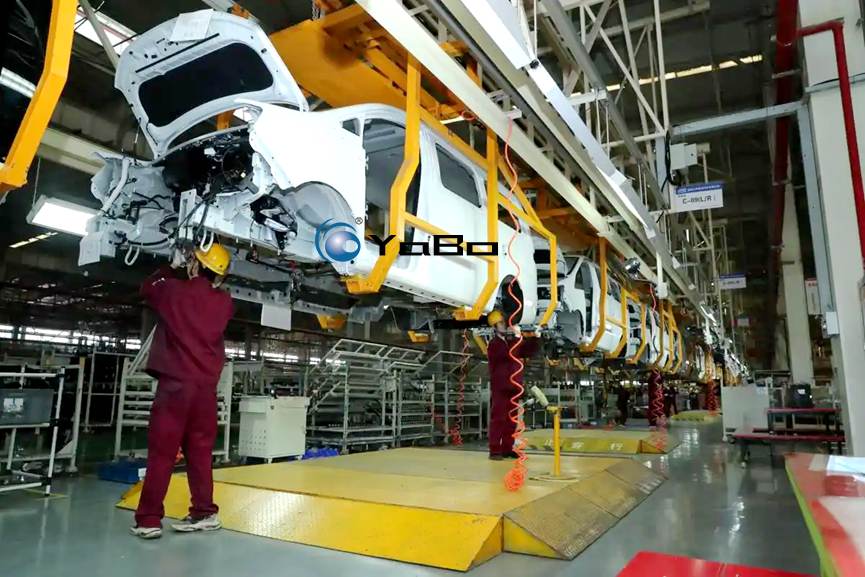
After the Body-in-White (BIW) from the welding shop enters the interior assembly zone of the automotive production line, it is first placed on a floor slat conveyor or self-propelled skate. The vehicle floor height is controlled at 400–450mm above the ground, allowing operators to stand naturally or sit on low stools to enter the vehicle and complete the installation of interior components such as the instrument panel assembly, wiring harnesses, carpets, HVAC units, and front wall soundproofing pads. The number of workstations in this section is flexibly set according to the complexity of the vehicle model. A body transfer station is set at the end of the section, where an electric hoist lifts the body off the ground, hangs it into the overhead suspension chain, and raises it to a height of 1.6–1.8m before sending it to the chassis assembly area.
2. Chassis Final Assembly Zone (Core Area of the Equipment)
Chassis final assembly is the core workstation of the automotive production line. The system uses a floor friction drag chain as the main conveying carrier, cooperating with one overhead transfer lifting platform at each of the entry and exit ends to complete the lifting and positioning of the vehicle body. The process flow is as follows:
(1) Infeed Lifting Platform: Vehicle Receiving and Lowering
The body is conveyed by the suspension chain to above the infeed lifting platform workstation. The heavy-duty support arms on both sides of the lifting platform rise to support the side skirts or longitudinal beams of the body and automatically decouple from the suspension hoist. The lifting platform then carries the body down to an assembly workstation height of approximately 1.4–1.6m above the ground, ensuring ample operating space under the vehicle.
(2) Drag Chain Accumulating Conveying and Precise Station Stopping
The body is smoothly placed on a drag chain trolley. The trolley is pulled forward along the pit track by sectional friction drive stations. A pneumatic block stopper is installed at the entrance of each assembly workstation. When the trolley arrives, the block pops up, disconnecting the trolley from the drive wheel to achieve precise positioning at the ±3mm level. The entire line drag chain speed is 6–10m/min, and the lifting platform speed is 4–5m/min. All the above parameters can be customized according to production line requirements.
(3) Chassis Major Assembly Content
After the body is stabilized, operators complete the following sequentially under the vehicle (can be combined or split according to the specific vehicle model process):
- Front suspension and subframe assembly (including steering gear and stabilizer bar)
- Rear suspension / rear subframe assembly
- Powertrain (engine + transmission or drive motor + reducer) hoisting and assembly
- Exhaust pipes, high-voltage wiring harnesses, fuel/cooling pipeline connections
- Fuel tank or power battery pack fixed installation
- Wheel assembly sub-assembly and on-line installation
Each workstation is equipped with manual or electric lifting trolleys to assist in assembly. Bolt tightening is done with torque-controlled tools, and tightening torque data can be stored locally or integrated into the workshop management system.
(4) Flexible Accumulation and Release
When the operation at a single workstation is completed, the operator presses the release button. The block lowers, and the trolley is driven again to enter the next workstation. If the downstream workstation is occupied by a vehicle, the current trolley automatically accumulates and waits in front of the block without pushing the preceding vehicle, forming a natural takt time buffer.
(5) Outfeed Lifting Platform: Lifting and Transfer Out
After all chassis assembly is completed, the body arrives at the outfeed lifting platform workstation. It is lifted by the second lifting platform, re-hung into the suspension chain or transferred to the floor final assembly line, completing the closed loop of the chassis section.
3. Final Assembly and Filling Zone (Floor Slat Line)
After the body is transferred out of the chassis section, it enters the final assembly and filling zone of the automotive production line, resuming floor slat conveying, with the vehicle floor about 750–850mm above the ground. This section mainly completes:
- Quantitative filling of various fluids (coolant, brake fluid, refrigerant, washer fluid)
- Installation of seats, seat belts, door trim panels, and sunroof interior panels
- Battery placement and wiring harness connection
- Final appearance inspection, label application, and VIN engraving
The number of workstations is flexibly arranged according to the actual assembly workload and matches the takt time of the chassis section.
4. Rain Test Booth
After final assembly and filling are completed, the vehicle directly enters the rain test booth—this is the final sealing quality checkpoint of the automotive production line before the vehicle leaves the assembly line. The rain test booth is a closed steel structure channel with spray pipes and fan nozzles arranged on multiple surfaces inside:
- Spray Layout: Nozzle arrays are set on the top and all around, with spray angles covering the entire vehicle surface without blind spots.
- Spray Standard: Executed according to GB/T 12480 or customer enterprise standards, typically 5–10mm/min for 2–5 minutes, all customizable.
- Water Quality and Temperature: Filtered circulating water is used, and the water temperature is controlled near room temperature to avoid condensation from being misjudged as leakage.
- Inspection Method: The vehicle slowly passes through the water curtain or remains stationary under the spray. After completion, quality inspectors check for leakage points inside the vehicle, trunk, and engine compartment. Non-conforming vehicles are transferred to the adjacent rework station.
- Water Circulation: Bottom water collection tank → sedimentation and filtration → pumped back to spray pipes, only replenishing evaporation and splash losses.
5. Performance Inspection Line
After passing the rain test, the vehicle is driven by an operator or automatically towed into the inspection line, passing through in sequence:
- Wheel Alignment Station: Roller alignment equipment detects and adjusts toe, camber, and caster angles.
- Lighting Tester: Automatically detects high/low beam intensity and aim position.
- Brake Test Bench: Roller reaction-type equipment tests braking force and distribution of each axle.
- Roller Dynamometer (Optional): Simulates road load to verify speedometer, ABS, abnormal noises, etc.
Inspection data is uploaded and archived in real time. Non-conforming items are guided to the rework area for processing.
6. Off-line Area
After passing inspection, the vehicle drives out and enters the finished vehicle parking area or road test track. At this point, the entire automotive production line assembly process is completed.
II. Key Equipment Technical Description
1. Overhead Transfer Lifting Platform
- Frame Structure: Double-column or four-column gantry frame, H-beam steel welded, surface hot-dip galvanized or coated with anti-rust paint, platform is a box girder structure.
- Transmission Method: Synchronous brake motor + ball screw/chain lifting, absolute encoder closed-loop positioning.
- Support Arms: Telescopic support arms on both sides, equipped with polyurethane buffer pads and profile positioning blocks at the ends, driven by cylinders, single action ≤4 seconds.
- Safety: Anti-fall safety clamps, upper/lower limit switches, overload protection, power-off self-locking.
2. Floor Friction Drag Chain System
- Track: Heavy-duty stamped track laid in a pit 250–300mm below the ground. The track surface is flush with the ground, not affecting passage.
- Drive: Sectional friction stations, geared motor drives a polyurethane wheel to press against the trolley drawbar. No rigid connection between trolleys, accumulating flexible pushing.
- Trolley: Four-wheel load-bearing, equipped with adjustable V-blocks/profile brackets on top, suitable for wheelbase 2300–3100mm, can be manually or servo adjusted, and other wheelbases can also be customized.
- Accumulation: When the downstream is blocked, trolleys accumulate in front of the block. The friction wheel idles without damaging the mechanism.
3. Positioning and Control System
- Stopper: Pneumatic block, lifting response ≤1.0 second, flush with the ground after retraction.
- Electrical Control Cabinet: Arranged along the line, built-in PLC/inverter/circuit breaker, protection class IP54.
- Operation Box: Each workstation is equipped with start/stop, emergency stop, reset buttons, and a three-color light.
4. Safety Protection Facilities
- Fencing: Yellow grid fences on both sides of the entire line, 1.2–1.5m high, doors equipped with safety interlocks.
- Audible and Visual Alarm: Rotating light on top + buzzer alert during start/stop.
- Cable Reel: Mobile power supply uses a floor automatic retractable cable reel.
III. Equipment Technical Parameters (Typical Reference Values, All Customizable)
| Item | Typical Parameter | Remarks |
|---|---|---|
| Applicable Models | Sedans/SUVs/MPVs/NEV models with wheelbase 2300–3100mm | Brackets can be customized |
| Annual Capacity | 10,000–150,000 units | Takt time and number of stations adjusted as needed |
| Design Takt Time | 60–720 seconds/unit (adjustable) | Customized according to capacity |
| Drag Chain Speed | 6–10m/min | Variable frequency adjustable |
| Lifting Speed | 4–5m/min | Adjustable |
| Single Unit Load Capacity | ≤2500kg | Can be increased |
| Positioning Accuracy | ±3mm | Customizable |
| Power Supply | Three-phase 380V/50Hz | Can be adjusted according to export country standards |
| Control | PLC centralized control + workstation operation box, reserved MES interface | — |
| Rain Test Intensity | 5–10mm/min (GB/T 12480 or customer standards) | Customizable |
| Environment | Indoor workshop, 0℃~40℃, humidity ≤90% | — |
IV. Applicable Scenarios
This equipment is suitable for various passenger car final assembly workshops with an annual output of 10,000–150,000 units, and is particularly suitable for:
- Small and medium-sized car companies with multi-model mixed-line production that require frequent product switching
- Old plant renovation projects with limited building height and a desire to reduce civil construction costs
- Transition solutions for co-line production of new energy vehicles and traditional fuel vehicles
- Complete set output for KD factories targeting overseas markets
The entire line features a modular design. Tracks, trolleys, lifting platforms, and rain test booths can all be non-standard customized according to actual plant dimensions.
V. System Overview
This equipment is a complete set of chassis assembly and vehicle inspection and conveying equipment for the final assembly workshop of automotive production lines for small and medium-sized vehicle manufacturers. It adopts the classic process combination of “overhead suspension storage and transportation + floor friction drag chain + lift transfer.” The system uses a floor accumulating drag chain as the main conveying backbone, cooperating with heavy-duty overhead transfer lifting platforms to achieve smooth transfer of the vehicle body in multi-layer spaces, fully covering the entire automotive production line process from Body-in-White loading, chassis final assembly, final assembly and filling, rain seal testing to performance inspection. The equipment operates stably with a wide adjustable takt time, adapting to the multi-variety mixed-line production demand of 10,000 to 150,000 units per year. All equipment specifications of the entire line can be non-standard customized according to customer plant dimensions, product structure, and capacity planning.

ø;