
I. Quick Overview of Motorcycle Types
Two-wheeled gasoline motorcycles break down into three basic body types, with further subdivisions under each:
Straddle-type (8 types): Commuter standard, Streetfighter (NK), Sportbike / Replica, Cruiser / Chopper, ADV / Adventure, Dirt bike / Off-road, Retro / Cafe racer, Mini straddle.
Scooter (5 types): Lightweight scooter, Urban commuter scooter, Maxi-scooter / Touring scooter, Sport scooter, Retro scooter.
Underbone / Step-through (4 types): Classic commuter underbone, Scrambler-style underbone, Commercial cargo underbone, Lightweight mini underbone.
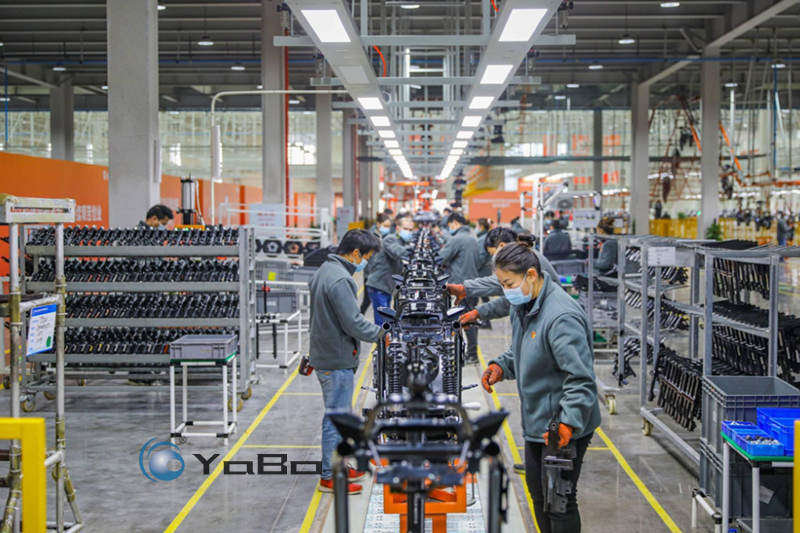
II. The motorcycle assembly line uses chain plates for planar conveying movements, which are generally driven by motors. The steel conveying chain is used for overall traction. The load-bearing steel plates and plastic plates are fixed on the chain elbows in the guide rails on both sides of the conveyor. As the conveying medium, they are connected and fixed together. As the overall load-bearing and conveying mechanism of the equipment, the motorcycle assembly line is an indispensable motorcycle assembly equipment for motorcycle manufacturers. As non-standard equipment, the production line is usually adaptively designed according to the customer’s product and production process requirements.
The assembly stations are transferred in order. The assembly line is equipped with standard configurations such as lighting, fans, and fixtures. The length of the production line can be selected according to the output (generally no less than 40 meters). Large pitch needle roller chains are used as the conveying medium, and metal panels are dragged and circulated (The conveying speed and time are adjustable), and the factory’s assembly process can be effectively adjusted through automated assembly line operations. Online testing can be reasonably configured for each process, automatic assembly machines can be installed on the production line, and effective product quality control and equipment operating status monitoring can be implemented to provide necessary guarantees for modern large-scale production.
Depending on its size, there are two types of chains: light and heavy
Light plate chain conveyors are usually used in the production of engines, generators and household appliances, and their station load capacity is generally between 100-30 kg;
Heavy chain conveyors are commonly used in the manufacture of automobiles, motorcycles, agricultural machinery and construction machinery. The carrying capacity of the station basically exceeds 1T.
Advantages of our motorcycle assembly line
1. Motorcycle assembly lines can effectively control the production time of motorcycle assembly lines and improve the stability and work efficiency of motorcycle assembly lines.
2. Generally, products are delivered gradually during the assembly process in accordance with the process flow to reduce the trouble of manual transfer or product turnover by workers.
III. Key Parameters
(Typical ranges — actual specs depend on the model and production volume)
|
Parameter
|
Common Range
|
|---|---|
|
Line width
|
400–650mm (standard); customizable 200–1200mm
|
|
Line height
|
~600mm, adjustable
|
|
Line length
|
800–40000mm, depends on number of stations
|
|
Conveying speed
|
0.5–10 m/min adjustable; heavy-duty lines up to 15
|
|
Operation mode
|
Continuous / Cycle-based (stop-and-go)
|
|
Takt time
|
Typically 60–180 seconds per unit
|
|
Load capacity
|
Light-duty ≥50kg/m; Heavy-duty ≥300kg/m; some up to 500
|
|
Chain pitch
|
50.8 / 100 / 200mm
|
|
Drive power
|
Commonly 3.7kW variable-speed motor; increase for longer lines or heavier loads
|
|
Number of stations
|
Determined by process; commonly 22 stations, ~2m spacing
|
|
Control method
|
PLC + VFD, compatible with MES
|
|
Surface treatment
|
Galvanized, chrome-plated, or rubber-coated — all options
|
IV. Considerations for Motorcycle Assembly Line Planning
Figure out takt first: Annual capacity target → single or double shift → how many units per day → back-calculate takt time. For example, 300 units/day over 8 hours gives roughly 96 seconds per unit. This number is the foundation for everything else in the design.
How to lay out the shop floor: The line direction needs to align with building columns, material flow paths, and feeding areas. Curves and inclines save floor space but make the equipment more complex. Leave buffer zones at both ends for loading and unloading — where frames stack up, where finished bikes go — plan that ahead.
Don’t let stations be unbalanced: Each station’s work time should stay close to the takt — if it drifts too far (more than ±10%), you’ve got a bottleneck. Station spacing is usually 1.8 to 2.5 meters — enough room for the worker to move and for parts to sit. For high-up work like installing the fuel tank, better to use a lift table or adjustable fixture — don’t make people tiptoe every day.
Logistics follows the line: Both sides need to allow AGVs or tow carts through. Heavy items like engines and frames should have staging areas close to their assembly stations. Empty rack return lines can run parallel to the main line.
Get it connected if you can: PLC linked to MES gives real-time data on output, takt, and line stops. Key stations like tightening and fluid filling should have torque monitoring and error-proofing, with data logged. You can always add AGV auto loading/unloading later.
Don’t skimp on safety and maintenance: At least one emergency stop per station, guards over chains and drive areas. Go with auto centralized lubrication if possible, and keep a backup drive on hand — less downtime means more money.
Leave some margin: When a new model comes in, you should be able to run mixed production just by swapping fixtures. Leave extra interfaces on the line length and control modules so adding stations later doesn’t require a major overhaul.