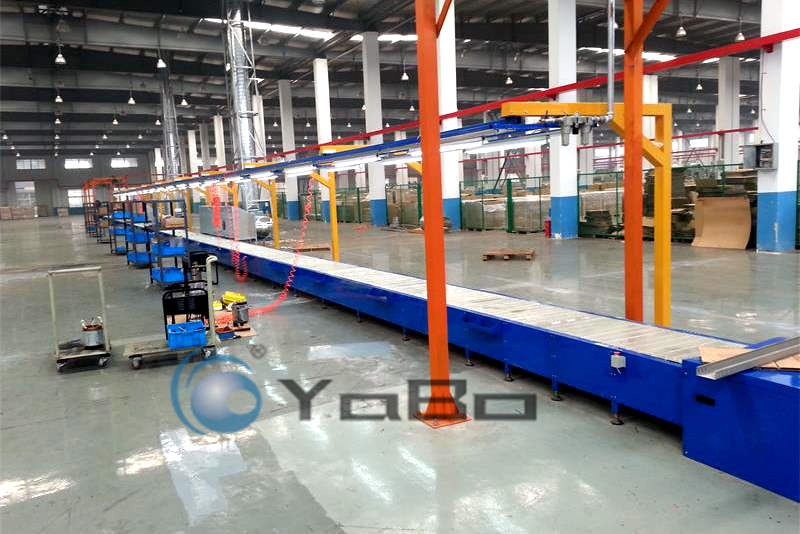

The electric motorcycle production line is a systematic manufacturing process designed specifically for electric two-wheelers. It differs fundamentally from traditional fuel motorcycle lines — instead of being built around engines, fuel tanks, and exhaust systems, the focus shifts to frame structure, the three-electric system (motor, battery, electronic control), lightweight body panels, and electrical assembly. The entire line balances production efficiency, process precision, and quality control while meeting the basic safety and environmental standards of the new energy vehicle industry.
The line adopts a modular architecture, flexibly accommodating various electric motorcycle models from 50cc to 200cc equivalent power — including urban commuters, off-road models, and heavy-duty commercial variants — enabling true multi-model collinear production and flexible mass manufacturing.
1. Frame and Body Panel Forming
Although electric motorcycles eliminate engine blocks and fuel tanks, sheet metal components such as the main frame, body panels, guards, and battery enclosure housings still require high-precision forming. Raw materials are primarily cold-rolled steel sheets and aluminum alloys.
Conventional hydraulic or pneumatic presses paired with dedicated dies handle cutting, drawing, and forming operations. The line supports quick die changeovers for multiple models, keeping dimensional tolerances within a reasonable range — this directly determines the fit-up accuracy for subsequent welding and the panel gap consistency during final assembly. Sealing flanges on the battery compartment and hole-position accuracy on controller mounting brackets all depend on this stage.
For customers with limited budgets or moderate production volumes, an alternative approach is to source standard stamped parts externally and implement incoming inspection, rather than building an in-house stamping shop.
2. Frame Welding: The Foundation of Strength and Safety
Stamped components are assembled into a complete frame and body structure at the welding stations. This is the core process determining the vehicle’s structural integrity.
The actual production setup consists of: skilled welders + dedicated positioning fixtures + CO₂ gas shielded welding or TIG welding equipment. The fixtures ensure accurate alignment of all joints, controlling distortion and misalignment at the source. Critical weld areas receive reinforcement plates. After welding, manual correction combined with simple inspection tools (such as coordinate measuring machine spot checks or template comparisons) verifies frame geometry, ensuring compliance with certification requirements for target export markets such as ECE and DOT.
Note: Electric motorcycle batteries are heavy and concentrated at the bottom, so the down tube and rear swingarm experience higher loads than comparable fuel models. Weld count and reinforcement plate placement need targeted optimization. This is managed through fixture design and welding procedure specifications, without relying on expensive automation.
3. Surface Painting
Welded frames and panels enter the paint line. The process follows industry-proven standards:
Degreasing and derusting → Water rinsing → Phosphating → Electrophoretic primer (or powder coating) → Color coat / clear coat spraying → Baking and curing
Small to mid-scale lines typically use a water-curtain spray booth + drying tunnel configuration, operating in an enclosed environment with basic exhaust gas and wastewater treatment facilities to meet local environmental requirements. Paint thickness and adhesion are controlled through on-site spot checks. For electric motorcycles, anti-corrosion coating around the battery compartment and on the underframe is especially critical, directly affecting vehicle service life.
4. Final Assembly and Motor Integration
Final assembly is the last process. The core difference from traditional lines lies in the completely reconfigured assembly logic for the three-electric system.
4.1 Motor and Reducer Pre-assembly
The motor, reducer, controller, and related components are integrated and wired at a dedicated pre-assembly station. After assembly, the unit is transferred to the main assembly line via manual hydraulic trolley or dedicated transfer cart, precisely aligning with the frame’s drive shaft or mid-mounted motor mounting position. This “off-line pre-assembly + on-line docking” approach prevents the main line stations from being tied up by lengthy precision component assembly.
4.2 Flexible Vehicle Assembly
The line uses adjustable positioning stops / quick-change fixtures to accommodate different frame sizes, enabling multi-model collinear production. Material delivery relies on line-side racks with scheduled replenishment — high-frequency small parts (bolts, washers, cable ties) are placed in suspended baskets or tiered racks beside the line, while large components (frames, battery packs, tires) are delivered to the corresponding stations by forklift or manual cart as needed. Work pacing is coordinated by the line supervisor on the shop floor, without depending on complex dispatch systems.
4.3 Core Equipment for Final Assembly: Slat Chain Conveyor System
Running through the entire final assembly shop, the straight heavy-duty slat chain assembly line with dual-sided workstations is the most mature and widely adopted solution in electric motorcycle factories worldwide. Its simple structure, low failure rate, and easy maintenance make it especially well-suited to factory environments in developing markets.
Line Layout and Material Flow Logic
Motorcycles are placed upright directly on the steel slats of the chain, with the front wheel resting on the surface — wheels without additional pallets, boasting a simpler structure — meaning no extra pallets or complex tooling are needed. The vehicle remains stable through its own weight and simple positioning stops. The slat chain advances at a set speed while workers stand on both sides of the line, performing assembly tasks at their assigned fixed stations. Vehicles move, workers stay put, and materials are picked up nearby — this is the most proven and time-tested efficiency model.
Above the conveyor line, compressed air lines, lighting, and tool suspension rails are fully integrated. Multi-tier suspended material baskets are installed on the right side, storing high-frequency small parts such as bolts, washers, and body panels. Workers can reach for them without walking, minimizing wasted motion.
Key Parameters
| Parameter | Typical Range | Notes |
|---|---|---|
| Slat width | 500mm – 1800mm | Covers underbone to heavy-duty EV models |
| Station load capacity | Several hundred kg – 2 tons | With battery pack, the whole vehicle is heavier; load capacity needs margin |
| Conveying speed | 0.4 – 4 m/min | Variable frequency speed control, manual/auto switchable |
| Operation mode | Continuous or intermittent tact | Stops at each station for a fixed duration, resumes after task completion |
| Station spacing | 500mm – 1000mm | Determined by operation content |
| Number of stations | 20 – 40 | Per single line |
| Takt time per unit | 2 – 5 minutes | Used to calculate single-shift output |
Mechanical Structure
The slat chain conveyor operates on a mature principle and is simple to maintain — in overseas factory environments with unstable voltage and rougher conditions, it proves more reliable than complex automated lines:
- Chains: Double-pitch roller chains or leaf chains — standard market parts, locally sourceable for replacement
- Slats: Stamped steel plates with flat surfaces to directly support wheels; galvanized carbon steel or stainless steel, resistant to oil and moisture
- Guide rails: Welded from channel steel or H-section steel, structurally solid
- Machine frame: Steel structure with powder-coated finish, rust-resistant and durable
- Drive unit: Standard three-phase motor + reducer + variable frequency drive — sufficient torque, easy to service
- Control components: Limit switches + push-button stations for start/stop and emergency stop protection (no sensor overkill)
- Tensioning unit: Screw tensioning or gravity tensioning to compensate for chain elongation
Routine Maintenance
Three tasks: chain oil lubrication, guide rail debris cleaning, and slat bolt tightness inspection. Chains can be oiled periodically with a manual oil can. Welding slag, metal shavings, and plastic burrs on the rails should be cleared promptly. Slat connecting bolts are inspected weekly. The maintenance threshold is extremely low — local workers can be trained and ready within half a day.
5. End-of-Line Inspection and Quality Delivery
After final assembly, every unit undergoes comprehensive testing: brake feel, lights and signals, horn, speed, steering flexibility, electrical continuity, and fastener re-tightening. Electric motorcycles require additional checks: battery pack wiring inspection, controller function test, throttle/brake lever signal verification, charger compatibility test charging, and sample road range testing. All issues are caught here to ensure every finished vehicle meets the factory standard.