
The Birthplace of Mobile Living: A Panoramic View of RV Assembly Lines
In the specialized vehicle manufacturing sector, RV assembly lines represent the most “human-centric” production environments. Unlike the cold mechanization of traditional automotive assembly, these facilities operate more like precision-engineered factories for “mobile furnished homes.” From a bare chassis to a finished recreational vehicle, this production line integrates the dual DNA of automotive engineering and interior craftsmanship.
Line Architecture: Flexible Stations and Modular Pacing
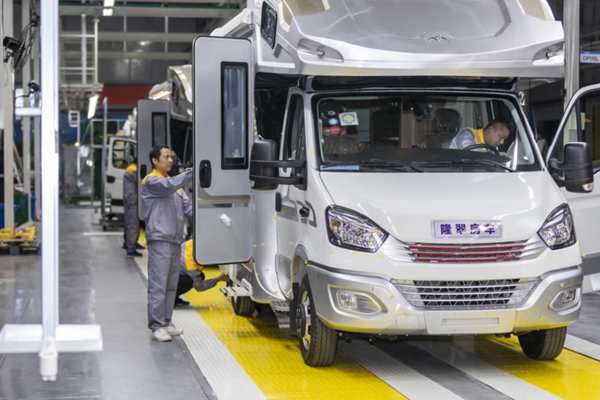
Modern RV assembly lines typically adopt an island-style station layout, breaking away from the rigid pacing constraints of conventional flow lines. Taking the production line shown in the image from Lecar RV as an example, chassis vehicles are parked in orderly fashion along yellow floor markings, while workers perform circumferential operations around the vehicles in open floor space. This layout stems from the “low-volume, high-variety” production characteristics of RV manufacturing—Type B, Type C, and Type T motorhomes must flexibly switch on the same line, with order configuration differences potentially involving dozens of variables including water/electrical capacity, furniture layouts, and slide-out configurations.
Line lengths typically range between 150-210 meters, incorporating 11-21 core stations. Unlike passenger vehicles’ overhead conveyor systems, RV lines predominantly utilize skid-based floor conveyance or AGV carts, with vehicles moving at slow speeds (2-5 meters per minute) through critical nodes including chassis reinforcement, utility installation, furniture fitting, and body mating. Station spacing is generously allocated because RV assembly involves extensive outsourcing component hoisting and multi-person collaborative operations, requiring more spacious working environments than conventional automobiles.
Process Depth: The Transformation from “Skeleton” to “Finished Interior”
The chassis upfitting stage represents a unique aspect of RV manufacturing. Workers first install sub-frame skeletons on the Type II chassis—these serve as the “foundation” connecting the chassis to the superstructure body, typically fabricated from galvanized square tubing with closed sections at critical points to prevent internal corrosion. Some high-end lines perform chassis modifications at this stage, including air suspension retrofits and enlarged water tank installations, with track width adjustments and powertrain upgrades also completed at this station.
Utility pre-installation constitutes the “vascular engineering” of the RV. Fresh water tanks (typically 100-200 liters) and grey water tanks are precisely positioned between the chassis longitudinal beams, pursuing left-right weight balance; 12V/220V dual-circuit electrical systems, hot/cold water plumbing, and gas lines are embedded along floor wire channels. All wiring harnesses utilize automotive-grade integrated looms, with connectors strictly differentiated by color and shape, providing traceability for future maintenance. This stage demands exceptional sealing performance, as pipe joints must withstand the dual challenges of vehicle vibration and thermal deformation.
Modular furniture assembly represents a core innovation in the production line. In dedicated sub-assembly areas, woodworking teams pre-assemble cabinetry, bed boxes, and kitchen modules in advance, with CNC routers ensuring dimensional precision; when chassis reach the corresponding station, complete modules are precisely positioned by lifting equipment, achieving “plug-and-play” installation. This process not only improves efficiency but also eliminates dimensional errors and internal stress accumulation associated with traditional on-site cutting. Large components such as integrated bathroom pods and overcab bed frames similarly employ modular hoisting, with workers completing final positioning and fastening inside the vehicle.
Body mating marks the critical moment of visual formation. Sandwich-structure wall panels (outer aluminum + insulation + inner PVC) are bonded using vacuum equipment, achieving high surface flatness; side walls, roof panels, and overcab sections are mated to the chassis using locating pins rather than traditional measuring and marking methods, controlling assembly tolerances to the millimeter level. Slide-out mechanisms are installed at this station, with the fit precision of rails and seals directly impacting future waterproofing performance.
Quality Closure: From Rain Testing to All-Terrain Validation
RV end-of-line inspection is far more complex than conventional vehicles. Beyond standard four-wheel alignment and brake testing, rain booths are equipped with spray nozzles covering six angles of the vehicle body, simulating torrential-level water pressure for extended periods to inspect sealing at body seams, windows, and air conditioning openings. Some facilities also feature shaker roads—cobblestone, washboard, and fish-scale patterns that simulate road conditions, validating the connection strength between superstructure and chassis, ensuring cabinet latches and plumbing joints remain
secure during long-distance vibration.
Interior air quality control permeates the entire process. Given the enclosed space and high furniture density of RVs, lines adopt an “inside-out” assembly sequence, allowing volatiles from panel adhesives and sealants to fully dissipate at open stations; VOC testing before delivery ensures formaldehyde and other harmful substance concentrations remain below passenger vehicle standards.
Technological Evolution: Digitalization and Lightweighting
Current RV assembly lines are undergoing technological iteration. Digital workstation terminals display assembly checklists and torque parameters in real-time, with critical processes scanned for traceability; intelligent automated warehouses pick materials by order, with AGVs delivering precisely to station sides, eliminating time wasted by workers retrieving components. On the materials side, one-piece molded fiberglass bodies and lightweight polymer composites are gradually replacing traditional aluminum-wood skeletons, reducing curb weight while improving thermal and acoustic insulation.
From chassis entry to finished vehicle exit, an RV typically undergoes 25-30 working days of assembly. This line produces not merely transportation equipment, but mobile spaces that carry lifestyles—every screw’s torque value, every bead of sealant application, provides reliable technical backing for “poetry and distant horizons.”
Email:yu.yblsx@gmail.com