
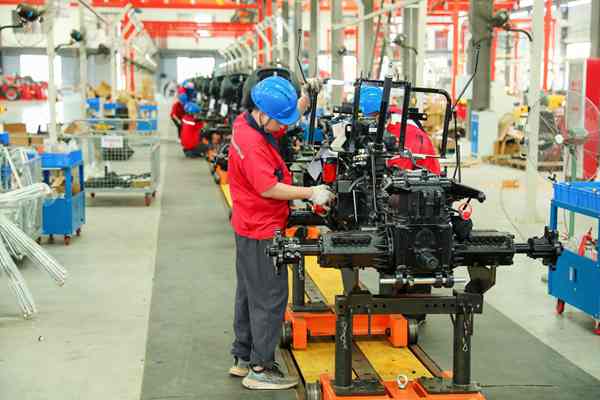
This is a typical agricultural machinery chassis assembly line, and operators are working on the transmission system at work. Different from home appliance assembly lines, agricultural machinery assembly lines face heavy components such as cast iron boxes, gear sets, and hydraulic components. Their process design must take into account high torque loading, multiple varieties of mixed lines, and reliability verification under outdoor working conditions.
1. Wire structure: evolution from rigid chain to flexible tray
The conveying carrier of the agricultural machinery assembly line has undergone significant technical iteration. In the early days, the ground chain traction type was widely used, which realized the station movement through the engagement of the chain plate and the tool tray. The structure was simple but the replacement was difficult. The current mainstream solution has shifted to a stack-type roller bed or sled conveying system-the pallet carries the entire chassis, the bottom is embedded in a guide groove, and is driven in sections by friction wheels or chains. The core advantage of this design lies in the “accumulation and release” function: when a certain workstation is delayed due to complex assembly, subsequent trays can be automatically temporarily stored to avoid stagnation of the entire line, which is particularly important for the production characteristics of multiple varieties and small batches of agricultural machinery. key. The line body is usually divided into the chassis pre-assembly section, the powertrain assembly section, the hydraulic and control system assembly section, the tire and panel installation section, and the offline debugging section. Buffer levels are set between each section, and the capacity is designed to be 3 to 5 units based on production capacity fluctuations, serving as a “reservoir” to absorb production fluctuations. A compressed air pipe network (pressure 0.6-0.8MPa) and a hydraulic oil circulation circuit are laid on both sides of the line body to provide power source for tightening tools, press-fitting equipment and lifting devices.
2. Key processes: precision assembly of transmission and power systems
The workstation where the operator is located in in the picture is likely to involve the assembly of the gearbox or rear axle assembly. This is one of the most technologically demanding links in the manufacturing of agricultural machinery chassis. Before assembly of the gearbox, the housing needs to be subjected to high-pressure spraying and vacuum drying by a cleaning machine to remove casting residues and processing debris. The cleanliness index usually requires that the weight of residual particles be less than 5mg/kg. The assembly sequence follows the principle of “from inside out, from bottom to top”: first place the main shaft, countershaft and shift fork mechanism, adjust the gear meshing side clearance (generally controlled within the range of 0.15-0.40mm), and then install the upper cover and shift mechanism. Key bolts, such as bearing cover fixing bolts, need to be controlled by torque-angle dual parameters. First, they are pre-tightened with the specified torque, and then rotated at a specific angle to tighten in the plastic zone to ensure that they do not loosen under bumpy conditions in the field. The traditional method of power assembly of the engine and gearbox relies on crane hoisting, which has poor alignment accuracy and low efficiency. Modern agricultural machinery lines generally introduce servo-assisted robotic arms or automatic guided vehicle (AGV) lifting platforms. The AGV carries the engine assembly on its back, identifies the installation reference holes on the chassis frame through the visual positioning system, automatically adjusts its attitude, and then slowly falls down, and cooperates with the operator to complete the bolt connection. This method compresses the assembly time from 15 minutes to less than 5 minutes, and eliminates safety hazards caused by hoisting. Hydraulic system assembly cannot be ignored either. The steering, suspension and driving of agricultural machinery rely on hydraulic circuits. Pipelines need to be pickled and phosphorized before assembly. Flaring or collet connection is used during assembly. Welding is prohibited to avoid oxide scale falling off and polluting the oil. Circularly flushing is carried out after assembly. The cleanliness of the oil must reach the ISO 4406 standard 18/16/13 level, which is equivalent to no more than 1300 particles larger than 4μm per milliliter of oil-this indicator directly determines the service life of the hydraulic valve core.
3. Man-machine cooperation mode and station design
The agricultural machinery assembly line has not been fully automated, the core reason is that the product volume is huge, the structure variability is high, and the annual output is not enough to amortize the huge investment in special equipment. Therefore, the focus of process design is on “ergonomic optimization.” The height of the work platform is set differently according to the operation content: the lifting platform or trench is configured in the operation area below the chassis, so that the personnel can complete the bottom bolt fastening in a standing posture; the upper pipeline connection station adopts a lifting pedal to avoid continuous arm lifting operation. The tool suspension system is arranged on the track above the line body. The balancer will offset the weight of the tightening tool to less than 0.5kg. The operator can control and accurately position it with one hand. Each workstation is equipped with an electronic work instruction (E-SOP), which breaks down the assembly steps in the form of pictures, texts and Short Video. Key size is marked in red boxes to prevent missed and wrong installation. The blue helmets and red tooling visible in the picture are standardized configurations on the agricultural machinery manufacturing site. Taking into account the risks such as burr of casting parts and leakage of hydraulic oil, fixed-point access cabinets for cut-resistant gloves, goggles, and oil-absorbing felt and other consumables are set up around the workstation to integrate occupational health protection into daily operations.
4. Inspection and debugging: from static assembly to dynamic verification
The end of the agricultural machinery assembly line is not a simple offline outlet, but a debugging area that integrates multiple functional verifications. The first is the “cold test”-when the engine is not ignited, theexternal motor pulls it to rotate, and the assembly quality of the crankshaft bearings and valve train is analyzed through vibration sensors and noise collectors to identify abnormal friction and clearance deviations. After passing the cold test, enter the “hot test”. The engine is ignited and run to monitor idle stability, oil pressure and exhaust smoke. The gearbox performs a no-load shifting cycle at each gear position to confirm that the synchronizer is engaged smoothly and without jams. Hydraulic system debugging is more complicated. It is necessary to connect a special test bench to simulate the load conditions of steering cylinders and suspension cylinders, and test the system pressure build-up time, internal leakage and temperature rise curve. Some high-end models are also equipped with CAN-bus diagnostic instruments to perform software calibration and fault code clearing on modules such as electronic shifting and power output shaft speed monitoring. The complete machine after passing the debugging is transferred to the coating line or directly into the finished product warehouse. It is worth emphasizing that the process closed-loop of the agricultural machinery assembly line does not stop at the factory-field fault data is fed back to the manufacturing end through the dealer network, driving the continuous iteration of the assembly process. For example, if the rear axle seal of a certain model frequently fails, it is traced back to the assembly line. In the oil seal press fitting process, adjust the concentricity of the pressure head or increase lubrication assistance.
5. The underlying logic of process management
The production scheduling model of agricultural machinery assembly lines is essentially different from that of automobile assembly lines. Automobiles are produced in large quantities in standardized quantities, while agricultural machinery is “seasonal explosion + coexistence of multiple varieties”-demand for tractors surged before spring plowing, orders for combine harvesters were concentrated before autumn harvest, and dozens of horsepower segments and functional configurations needed to be derived from the same platform. Therefore, the core of process management of the assembly line lies in “modular pre-assembly” and “rapid switching of final assembly.” The engine, gearbox, front axle, rear axle and other assemblies are assembled and tested in advance on the assembly line and sent to the assembly line as “black box” modules. The final assembly line only completes the connection between modules and frames and the docking of pipelines, which greatly shortens the occupation time of the main line. The module interface adopts a standardized design. Engines in different horsepower sections can be adapted to the same frame platform by adjusting the mounting hole position of the suspension bracket, realizing “platform-based” mixed-line production.
Email:yu.yblsx@gmail.com