
1. Specialized Assembly Equipment
Specialized machines are key equipment for automated and semi‑automated operations in various assembly steps. In EV production lines, common special machines include:
- Battery Assembly Equipment – used for cell stacking, module assembly, battery pack sealing, and welding.
- Motor Assembly Equipment – covers rotor pressing, stator winding, assembly testing, and dynamic balancing calibration.
- Body and Chassis Assembly Equipment – includes body‑joining fixtures, chassis‑suspension installation systems, laser welding stations, etc.
These machines significantly improve assembly accuracy and consistency, ensuring the quality of core EV components.
2. Production Line Conveying Systems
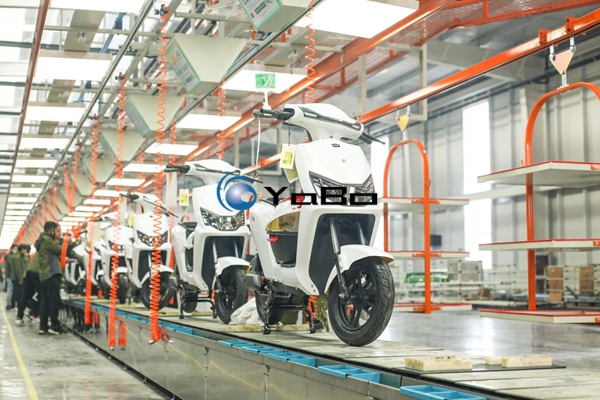
The conveying system is the core logistics equipment of the production line, used for continuous transfer of parts and work‑in‑progress between stations. Common forms include:
- Continuous Conveying Equipment: roller conveyors, slat conveyors, lift‑transfer units.
- Flexible Conveying Systems: AGV/AMR, overhead chain conveyors, robot seventh‑axis tracks.
- Positioning and Buffering Devices: servo‑driven lifting‑rotation tables, shuttle cars, automated storage/retrieval system interfaces.
The stability and efficiency of the conveying system directly affect the line’s cycle time and production flow.
3. Inspection and Testing Equipment
To ensure vehicle quality, the production line must be equipped with various inspection devices for comprehensive testing of assembled workpieces. Major categories include:
| Inspection Category | Typical Equipment | Test Items |
|---|---|---|
| Electrical Performance | Battery tester, motor test bench | Charge/discharge characteristics, output torque, energy efficiency |
| Structural Safety | X‑ray inspection system, ultrasonic flaw detector | Weld quality, internal material defects |
| Appearance & Dimensional | Machine vision inspection system, 3D laser scanner | Paint defects, assembly gaps, contour accuracy |
| Functional Verification | On‑board diagnostic tool, brake/steering test bench | Electronic control functions, dynamic performance calibration |
Real‑time inspection allows for timely problem identification and correction, enhancing product reliability and safety.
4. Assembly Tools and Tooling
The production line also requires a series of basic tools and tooling to support manual and automated assembly tasks, such as:
- Fastening Tools: servo torque wrenches, intelligent tightening spindles, preset torque guns.
- Pneumatic/Electric Tools: automatic screw‑feeding systems, adhesive dispensers, riveting tools.
- Positioning and Clamping Tooling: modular tooling plates, pneumatic fixtures, flexible modular jigs.
- Auxiliary Equipment: vacuum lifters, balancers, assist‑arm manipulators.
These tools enhance assembly efficiency and accuracy while reducing labor intensity and operational errors.
5. Electrical and Automation Control Systems
The production line must be equipped with automation control systems to monitor and regulate the production process. Key components include:
- Sensing and Actuation Layer: photoelectric/position sensors, RFID readers, servo drives, pneumatic actuators.
- Control Layer: PLCs, industrial PCs, robot controllers, motion control cards.
- Monitoring and Scheduling Layer: SCADA systems, MES terminals, digital twin platforms.
Automation systems not only improve line stability and production efficiency but also reduce the likelihood of human error and production incidents.
Email:yu.yblsx@gmail.com