
Facility Overview
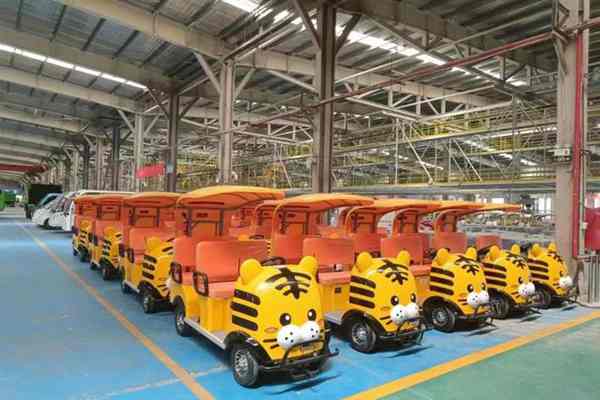
Inside our final assembly shop, a flexible assembly line purpose‑built for low‑speed electric sightseeing vehicles comes into view. The photograph shows a row of tiger‑themed electric carts staged along a blue painted aisle, each positioned at sequential workstations as it progresses through the build cycle. This is more than the end of the production journey—it is where stamping, welding, paint, and final assembly converge into a single, synchronized operation.
Line Architecture: Modular Design, Integrated Execution
Our assembly floor follows a “segment‑standalone, line‑integrated” philosophy. The main line comprises four linked modules:
- Trim Assembly Line
- Chassis Marriage Line
- Final Assembly Line
- End‑of‑Line Verification Station
Bodies arrive from the paint shop after cathodic electrocoating and topcoat application, then enter the final assembly area via the loading buffer.
Trim Assembly Line
- Uses an accumulating power‑and‑free roller conveyor with a dual‑level loop
- Upper level: carries pallets through assembly stations
- Lower level: returns empty pallets to the start
- Lift tables at each end handle pallet transfer
- Spans ~250 meters with over 30 stations
- Operations include:
- Door removal (assisted by lift‑assist manipulators to protect paint)
- Full‑vehicle wiring harness installation
- HVAC module fitting
- Instrument panel assembly
- Front/rear bumper and windshield installation
Doors travel on a dedicated sub‑assembly conveyor where window regulators, speakers, and weatherstrip seals are fitted, then return to the main line for reinstallation in a one‑to‑one matched sequence.
Chassis Marriage Line
- Employs a height‑adjustable overhead carrier system (EMS with VAC fixtures)
- Adapts to each vehicle variant for optimal ergonomics
- Powertrain units, suspension modules, and battery packs are pre‑assembled on independent sub‑lines
- AGVs deliver pre‑built modules to the body underside
- A lift table raises the module into position for precise body‑to‑chassis joining
This “sub‑line pre‑build, main‑line marriage” approach compresses takt time on the main line and improves overall balance.
Final Assembly Line
- Handles seat installation, wheel torqueing, fluid fill, and pre‑delivery inspection
- Uses a mix of electric and pneumatic tooling
- Critical torque values are captured and retained in real time for full fastener traceability
Flexible Manufacturing: Mixed‑Model Production with Rapid Changeover
A defining feature is the ability to handle multiple vehicle configurations on a single conveyor. Whether the order calls for:
- A four‑seat leisure model
- An eight‑seat shuttle
- A themed custom unit (e.g., tiger carts)
…the line adapts through strategically placed assembly islands:
- Fixed stations handle standard operations
- Flexible islands accommodate variant‑specific tasks
This hybrid layout preserves the efficiency of a paced line while delivering the responsiveness required for low‑volume, high‑variety production.
Conveyor speed is continuously variable from 1.0 to 3.0 m/min, synchronized with operator skill level and task complexity. Each station is equipped with:
- Compressed air drops
- Task lighting
- Dedicated fixtures
Line speed is governed by actual operator performance rather than an arbitrary fixed rate.
Smart Logistics and Quality Control: Data‑Driven Operations
Set Parts Supply (SPS) System
- Material handlers sequence parts in build order onto dedicated SPS carts
- Carts shadow each vehicle through the line
- Large items (instrument panels, tires, seats) are delivered directly to stations by AGV
This minimizes manual handling and maximizes uptime.
Embedded Quality Assurance
After build completion, each vehicle passes through:
- Wheel alignment
- Headlamp aiming
- Side‑slip testing
- Chassis dynamometer evaluation
- Brake performance testing
- Water‑leak verification
Key data points are automatically collected and archived.
Kanban‑Driven Pull System
- Operators signal consumption with withdrawal kanban cards
- Logistics center replenishes materials in exact sequence
- Reduces WIP inventory and frees floor space
Conclusion
From body‑in‑white to final sign‑off, our sightseeing vehicle assembly line combines a paced main line with flexible assembly islands to deliver both throughput and customization capability.
Every unit rolling off this floor carries more than passengers through a resort or park—it carries the output of a final assembly process engineered for precision, efficiency, and quality. This is how we, as a dedicated assembly line builder, translate manufacturing process innovation into a competitive advantage for our customers.
Email:yu.yblsx@gmail.com