Introduction to the Assembly System
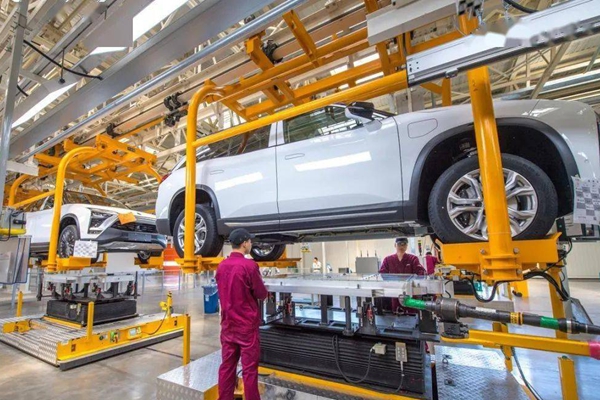
The image captures a sophisticated automotive assembly line in operation, showcasing the culmination of decades of industrial engineering evolution. This is not merely a production facility. It is a meticulously choreographed system where mechanical precision meets human expertise. The assembly line depicted represents the backbone of modern automotive manufacturing, where raw components are transformed into finished vehicles through a series of synchronized, sequential operations.
Structural Architecture and Material Handling
Overhead Conveyor Infrastructure
At the heart of this assembly system lies the overhead conveyor infrastructure, painted in industrial yellow, a color chosen for high visibility and safety compliance in manufacturing environments. The overhead carriers, or skillets, serve as the primary material handling mechanism, suspending vehicle bodies at an ergonomic working height. This inverted suspension approach is a deliberate engineering choice. It allows workers to access the undercarriage, wheel wells, and lower chassis components without the physical strain of bending or crawling.
Motion Control Principles
The conveyor system operates on a continuous or intermittent motion principle, depending on the specific workstation requirements. In areas requiring detailed manual assembly, the line may employ a stop-and-go indexing system, where the carrier pauses at each station for a predetermined cycle time, typically 60 to 90 seconds in high-volume automotive plants. This indexing ensures that operators have stable, vibration-free conditions for precision tasks such as torque-critical fastener installation or electrical connector mating.
Workstation Design and Ergonomic Integration
Integrated Workstation Platform
The assembly stations visible in the image demonstrate advanced ergonomic engineering. The platform beneath the suspended vehicle is not merely a floor surface. It is an integrated workstation designed to position tools, components, and sub-assemblies within the operator’s golden zone, the optimal reach envelope that minimizes shoulder and back strain. The black equipment housing beneath the platform likely contains power tools, torque monitoring systems, and programmable logic controllers that govern station-specific operations.
Human-Machine Collaboration
The workers, dressed in standardized burgundy uniforms, represent the human element in this automated environment. Their positioning indicates a division of labor typical of automotive assembly. One operator appears to be engaged with underbody components, possibly powertrain or exhaust system installation, while the second manages supervisory or secondary assembly tasks. This parallel processing within a single station maximizes labor utilization and reduces overall cycle time.
Process Flow and Sequential Operations
Hierarchical Assembly Sequence
Automotive assembly lines follow a strict hierarchical sequence, and the image likely captures a mid-stage operation, possibly the chassis marriage station or final trim line. Preceding stations would have completed body-in-white welding, painting, and initial structural assembly. The vehicles shown appear to be in the body drop phase, where the painted body shell is joined with the completed chassis and powertrain assembly.
Takt Time Synchronization
The sequential nature of the line means that each station is both a consumer and a producer. It receives a partially completed vehicle from the upstream station, performs value-adding operations, and releases it to the downstream station within the takt time, the rhythm of production dictated by customer demand. This takt time calculation is fundamental to lean manufacturing. If market demand requires 500 vehicles per shift, the takt time might be 72 seconds per unit, and every station must complete its operations within this window.
Quality Control and Traceability Systems
In-Process Quality Assurance
Modern assembly lines integrate quality assurance directly into the process flow rather than treating it as a terminal inspection activity. The equipment visible at each station likely includes torque-controlled power tools with data logging capabilities, ensuring that every critical fastener is tightened to specification and that this data is archived for traceability. Should a quality issue arise post-production, manufacturers can trace the exact tool, operator, and time of installation for any component.
Andon Communication System
Additionally, the assembly line likely employs an Andon system, a visual control mechanism using colored lights or digital displays to signal station status. Green indicates normal operation. Yellow calls for supervisory assistance. Red triggers a line stop. This immediate escalation protocol prevents defect propagation. If a station cannot complete its operations within takt time or detects a quality anomaly, the entire line halts rather than passing the problem downstream.
Automation and Human-Machine Collaboration
Hybrid Manufacturing Philosophy
While the image emphasizes manual assembly stations, these exist within a broader automated ecosystem. Robotic systems likely handle preceding operations such as welding, painting, and heavy component installation, while the stations shown focus on tasks requiring human dexterity, judgment, and adaptability. This hybrid approach, automation for consistency and speed in repetitive, heavy, or hazardous tasks and human operators for complex, variable, and precision-sensitive operations, represents the current state-of-the-art in automotive manufacturing philosophy.
Precision Movement Control
The conveyor carriers themselves are automated, moving at controlled speeds and stopping with positional accuracy within millimeters. This precision ensures that automated equipment at other stations, such as robotic sealant dispensers or automated guided vehicles delivering components, can interface reliably with the vehicle body.
System Attributes Summary
| Attribute | Characteristic | Operational Impact |
|---|---|---|
| Conveyor type | Overhead skillet system, yellow painted | Ergonomic undercarriage access, safety visibility |
| Motion control | Stop-and-go indexing | Stable conditions for precision assembly |
| Cycle time | 60-90 seconds per station | Synchronized with takt time requirements |
| Workstation design | Integrated platform with golden zone reach | Reduced operator strain, optimized tool access |
| Labor allocation | Parallel processing within stations | Maximized labor utilization |
| Assembly phase | Mid-stage body drop operation | Chassis marriage and final trim |
| Quality system | Torque logging, Andon visual control | Full traceability, immediate defect escalation |
| Automation approach | Hybrid human-robot collaboration | Balance of consistency and adaptability |
Conclusion
The assembly line depicted in this image is far more than a conveyor belt with workers alongside it. It is a complex socio-technical system where mechanical engineering, ergonomics, information technology, and human skill converge. Every structural element, from the overhead carrier geometry to the workstation platform height, has been optimized through iterative design and continuous improvement methodologies.
The yellow overhead structure, the suspended vehicle bodies, and the focused operators collectively represent one of humanity’s most sophisticated manufacturing achievements, a system capable of producing thousands of complex, safety-critical products daily with consistent quality and efficiency. In an era of increasing automation, this image reminds us that the most effective manufacturing systems remain those that orchestrate the complementary strengths of both human capability and mechanical precision.