
1. Overview of production line technology
Our sightseeing vehicle assembly production line adopts a modular design concept and integrates mechanical engineering, electrical automation and information management technologies. It is specially designed for the mass production of low-speed electric sightseeing vehicles, fuel-fired sightseeing vehicles and specially modified models. The total length of the production line can be flexibly configured according to production capacity needs, and the standard configuration supports the annual production capacity of 3,000 – 5,000 units per shift.
Core technical characteristics:
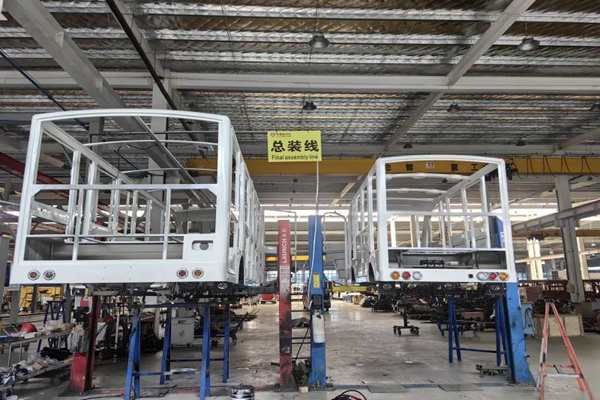
1. The flexible assembly platform system production line is equipped with a multi-station hydraulic lifting platform (as shown in the picture), which can be vertically adjusted by ±200mm according to the chassis height of different vehicle models to achieve ergonomical optimization. The platform has a load-bearing capacity of 2 tons and is suitable for a full range of sightseeing models from 2 to 23 seats, shortening the replacement time to less than 30 minutes.
2. The ground drag chain conveying system adopts a frequency-controlled ground drag chain conveying line, with a stepless adjustable running speed of 0.5-5m/min, and a positioning accuracy of ±5 mm. The transportation system is linked with the MES manufacturing execution system to realize the full traceability of vehicle VIN codes, and the operation data of each workstation is collected and uploaded in real time.
3. The intelligent material distribution system production line is equipped with AGV unmanned carriers and intelligent material racks, based on electronic signage pull-type material replenishment. Key components (battery pack, motor, controller) adopt RFID identification and error prevention system to ensure zero assembly errors.
2. Sightseeing car production process
The first stage: The frame assembly at the chassis pre-assembly station enters the first station of the production line after shot blasting and rust removal and electrophoretic coating. Here, the sub-assembly and assembly of the front suspension, rear axle, steering system, and braking system are completed. The torque controllable electric tightening shaft is used, and the torque values of key bolts are automatically recorded and archived to ensure the reliability of chassis connection.
The second stage: The electric sightseeing car with integrated power system completes the installation of the three-electric system (battery, motor, electronic control) at this station. The battery pack is accurately placed into the cabin through special lifting tools, and the high-voltage wiring harness is connected according to IP67 protection standards; the motor and reducer are assembled together in one time using pre-aligned tooling. For fuel models, the engine, gearbox, and fuel lines are assembled.
The third stage: Body assembly The body skeleton (such as the white frame structure in the picture) is assembled with the chassis through crane hoisting. This workstation is equipped with multiple sets of positioning fixtures to ensure the installation accuracy of the body and chassis. Subsequently, interior and exterior decoration are assembled: instrument panels, seats, ceilings, glass, lamps, etc. are installed in order, and standardized work instructions (SOPs) are used to ensure quality consistency.
The fourth stage: Electrical system debugging completes the installation and preliminary inspection of low-voltage wiring harness connections, lighting signal systems, audio systems, and intelligent vehicle-mounted terminals (GPS positioning, voice broadcast). Use a special diagnostic instrument to read the data of the vehicle controller to verify that the communication of each electronic control unit is normal.
The fifth stage: Off-line inspection of the entire vehicle passes the performance test line, and four-wheel alignment, braking force test, side slip detection, light adjustment, and rain tightness test are completed in turn. Finally, a dynamic test on the road test track was carried out to verify acceleration performance, steering flexibility, braking effectiveness and NVH performance.
3. Quality assurance and intelligence
The production line is equipped with an Andon system. Any abnormality found at any workstation can immediately trigger a sound and light alarm and suspend the production line. Problems will not flow out of this workstation. Critical quality data is monitored in real time through the SCADA system, and SPC statistical process control charts are generated to achieve quality early warning.
We also provide turnkey engineering services, covering production line planning, process design, equipment manufacturing, installation and debugging, and personnel training, helping customers quickly form large-scale and standardized sightseeing vehicle manufacturing capabilities.
Email:yu.yblsx@gmail.com