
I. The Wave of Intelligent Manufacturing Sweeps the Automotive Production Sector
In modern automobile manufacturing plants, a profound transformation driven by intelligent manufacturing is continuously upgrading on the production lines. From the first steel plate in the stamping workshop being accurately fed into the 10,000-ton press, to hundreds of robots in the welding workshop waving their arms to complete the seamless splicing of thousands of solder joints amid splashing sparks; from the fully automatic spraying robots in the coating workshop achieving uniform control of nano-scale film thickness, to the AGV trolleys in the assembly workshop shuttling silently along magnetic-guided paths to accurately deliver thousands of components such as engines, dashboards, and seats to assembly stations—automotive production lines have evolved into a highly collaborative, data-driven organic whole.
II. Intelligent Production Lines: The Perfect Integration of Precision and Rhythm
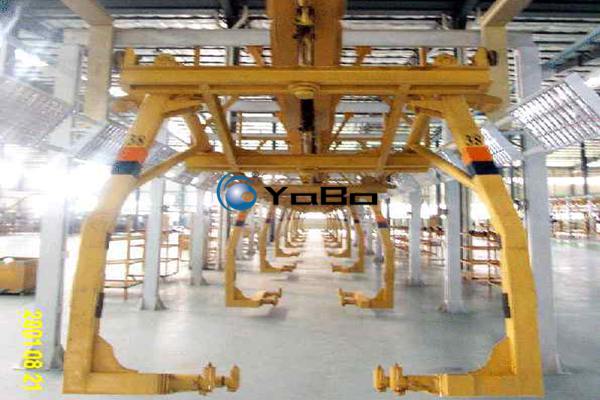
This production line is a model of precision and rhythm. The car body flows smoothly on the overhead conveying system, and the residence time at each station is accurately calculated in seconds:
- At the chassis assembly station, high-precision lifting equipment aligns the chassis and body holes to the micrometer level;
- At the fully automatic tire installation workstation, the robotic arm grabs the tire, the vision system identifies the bolt holes, and tightening is completed in an instant;
- The windshield gluing robot draws a perfect sealing curve at a constant speed and pressure;
- Next to the interior assembly line, the smart material rack lights up indicator lights on time to guide employees in accurate picking and assembly.
Every operation of the production line is converted into data in real time, aggregated into the digital twin model of the central control system, enabling predictive maintenance and process optimization. This is not only the flow of physical components, but also the surge of information and technological application.
III. Perception and Decision-Making: Core Capability Upgrades of Production Lines
Visual inspection systems act like “sharp eyes” on the production line, identifying tiny defects online; sensor networks continuously monitor thousands of parameters such as torque, pressure, and temperature. Modern production lines are no longer just “executors” of instructions, but have gained enhanced perception and decision-making capabilities:
- They are evolving from large-scale standardized manufacturing to a new production model that supports personalized customization;
- The core change lies in endowing production lines with the ability to “analyze” and “improve”—no longer passively executing, but actively perceiving, adjusting in real time, and optimizing continuously.
IV. Under the Wave: Redefining the Future of Automotive Manufacturing
When we talk about the future of automobile manufacturing, we are essentially discussing how this increasingly sophisticated, agile, and reliable production line redefines efficiency, quality, and potential. The core of the intelligent manufacturing wave is to break the traditional boundaries of production lines, enabling them to integrate perception, analysis, decision-making, and adaptive capabilities as the core of the industrial ecosystem.
The wave has arrived, and the future is here.
Email:yu.yblsx@gmail.com