
I. Project Background: Upgrade Demand Amid Manufacturing Cost Pressures
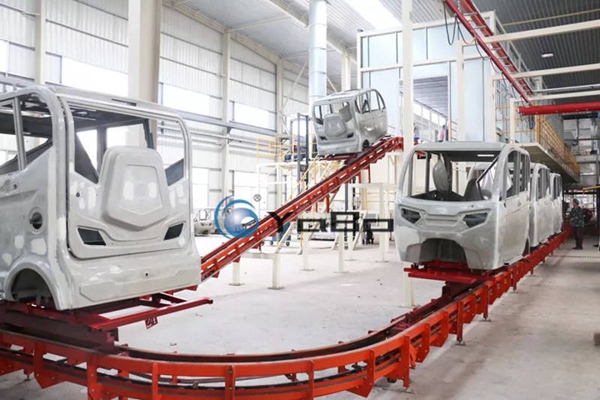
With the continuous increase of cost pressure in the manufacturing industry, tricycle production enterprises have put forward higher requirements for the cost control capabilities of production lines. To this end, our company tailored and implemented an intelligent production line project for a tricycle manufacturer. By optimizing the layout and process design, we ultimately achieved the core goal of reducing the single-unit production cost by more than 20%, building a market competitive advantage for the customer.
II. Core Cost Bottlenecks of Traditional Production Lines
Through a comprehensive review of the customer’s original production process, three key cost pain points of the traditional production line were identified:
- Long material transfer distance between processes, leading to high logistics costs;
- Insufficient utilization of some workstations, resulting in resource waste;
- Lack of process stability, leading to high product rework rates.
III. Optimal Solutions for Intelligent Production Lines
In response to the above bottlenecks, the project team carried out a comprehensive upgrade from four dimensions: layout, equipment, quality control, and energy consumption:
(1) Optimize Production Layout and Shorten Logistics Links
- Abandon the traditional linear layout and adopt a U-shaped production line design, reducing the average material handling distance between processes from 35 meters to 12 meters;
- Equip with an intelligent material distribution system that real-time tracks material positions through RFID technology and realizes precise distribution through automatic scheduling of AGV trolleys;
- Direct results: The number of logistics personnel is reduced by 40%, and material turnover efficiency is increased by 60%.
(2) Scientifically Configure Equipment and Improve Resource Utilization
- Based on Time-Action Research, accurately calculate the time consumption of each process and implement a “one machine with multiple functions” equipment configuration plan;
- Equip key workstations with multi-functional machining centers that can complete multiple processes such as milling, drilling, and tapping simultaneously, reducing equipment investment and floor space;
- Optimize the operation rhythm of each process using production line balancing technology, increasing the overall equipment efficiency (OEE) from 65% to 85%.
(3) Strengthen Process Quality Control and Reduce Rework Costs
- Set up 7 online inspection points on the assembly line, equipped with a machine vision system to real-time monitor key dimensional parameters;
- Establish a closed-loop quality control mechanism: when parameter deviations are detected, the system automatically adjusts equipment parameters to avoid defective products from the source;
- Core results: The first-pass yield of products increased from 92% to 98%, and the rework rate decreased by 70%.
(4) Build an Energy-Saving System and Reduce Energy Consumption Costs
- Introduce an energy management system to real-time monitor the energy consumption of individual equipment. By optimizing start-stop strategies and replacing with high-efficiency and energy-saving motors, the overall energy consumption of the production line is reduced by 25%;
- Adopt an intelligent lighting control system that automatically adjusts illuminance according to the actual needs of the production area, further reducing energy expenditure.
IV. Project Implementation Results: Data Proves Value
(1) Operational Stability and Production Capacity Performance
- The production line has been operating stably for 6 months since it was put into operation, with a total output of more than 15,000 tricycles;
- Customer feedback: The stability and reliability of the production line fully meet the expected standards.
(2) Core Achievements in Cost Optimization
- After comprehensive calculation, the single-unit production cost has been reduced by 22.3% compared with that before the transformation, exceeding the preset target;
- The project investment payback period is expected to be only over 1 year.
(3) Market Competitive Advantage
The cost optimization results have won valuable advantages for the customer in the fierce market competition and strengthened its industry competitiveness.
V. Future Planning: Technology Promotion and In-depth Upgrade
In the future, we will continue to deepen the research on cost control technology and plan to promote and apply this production line design solution that combines efficiency improvement and cost optimization to more manufacturing fields, helping manufacturing enterprises achieve high-quality development.
Email:yu.yblsx@gmail.com