
I. Main Classification of Motorcycle Models
Two-wheeled gasoline motorcycles are mainly divided into three core categories with distinct structural differences, laying the core foundation for differentiated assembly line design. Each category covers multiple mainstream models for diversified market demands:
Straddle-type (8 categories): Commuter standard, Streetfighter (NK), Sportbike / Replica, Cruiser / Chopper, ADV / Adventure, Dirt bike / Off-road, Retro / Cafe racer, Mini straddle.
Scooter (5 categories): Lightweight scooter, Urban commuter scooter, Maxi-scooter / Touring scooter, Sport scooter, Retro scooter.
Underbone / Step-through (4 categories): Classic commuter underbone, Scrambler-style underbone, Commercial cargo underbone, Lightweight mini underbone.
Significant differences exist in vehicle weight, frame structure, wheelbase and assembly processes among different models, which determines that standardized general assembly lines cannot meet production needs, and customized planning is essential.
II. Working Principle of Motorcycle Final Assembly Line
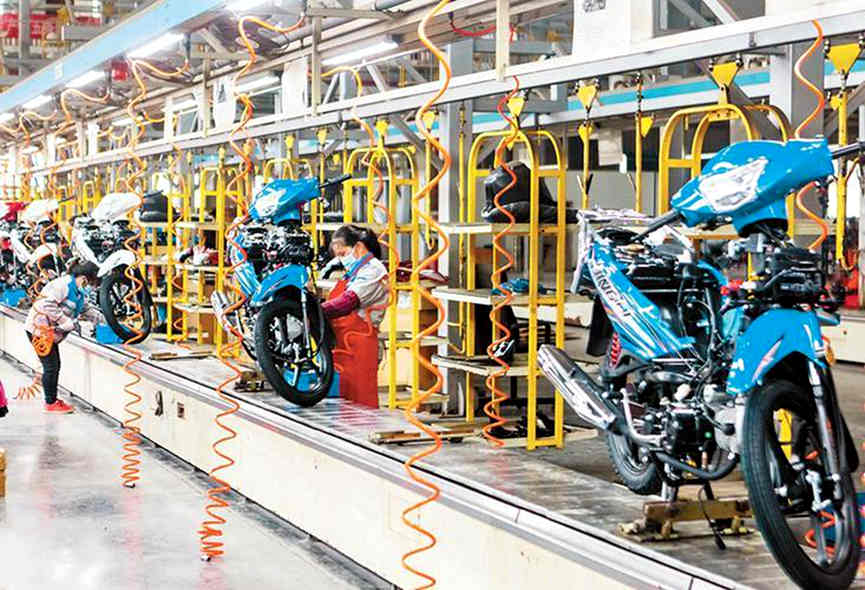
Final assembly is the core terminal process of motorcycle manufacturing. The whole vehicle frame is fixed on the conveying equipment and flows along the assembly line. Workers on both stations complete sequential operations including engine installation, fuel tank assembly, wiring harness laying and wheel fitting. A complete and drivable motorcycle is finished after all offline inspections.
The circulating slat conveyor is the standard and exclusive conveying equipment for motorcycle assembly lines. It adopts pin-connected metal plate structure, matched with driving motor, guide rail, tensioner and PLC control system. It supports two operation modes: continuous circulating operation and fixed-cycle intermittent start-stop operation. The system is compatible with full-model production, covering light underbone motorcycles and heavy cruisers up to 300kg.
The assembly line layout is highly flexible. According to factory space and process planning, it can be designed into straight, inclined, curved and segmented split structures, adapting to different workshop site conditions.
III. Core Technical Parameters of Assembly Line
The following are universal standard parameter ranges for motorcycle assembly lines. The final configuration is dynamically adjusted according to target vehicle models, daily output and production process standards:
|
Parameter
|
Common Range
|
|---|---|
|
Line width
|
400–650mm (standard); customizable 200–1200mm
|
|
Line height
|
~600mm, adjustable
|
|
Line length
|
800–40000mm, depends on number of stations
|
|
Conveying speed
|
0.5–10 m/min adjustable; heavy-duty lines up to 15 m/min
|
|
Operation mode
|
Continuous / Cycle-based (stop-and-go)
|
|
Takt time
|
Typically 60–180 seconds per unit
|
|
Load capacity
|
Light-duty ≥50kg/m; Heavy-duty ≥300kg/m; some up to 500kg/m
|
|
Chain pitch
|
50.8 / 100 / 200mm
|
|
Drive power
|
Commonly 3.7kW variable-speed motor; increase for longer lines or heavier loads
|
|
Number of stations
|
Determined by process; commonly 22 stations, ~2m spacing
|
|
Control method
|
PLC + VFD, compatible with MES
|
|
Surface treatment
|
Galvanized, chrome-plated, or rubber-coated — all options
|
IV. Necessity of Customized Assembly Line for Different Models
The huge differences in motorcycle weight, frame structure and assembly processes make universal assembly lines impractical. All mainstream models require targeted line body and fixture customization, with typical differentiated requirements as follows:
Lightweight scooter (≤50cc): The vehicle weight is only 80–100kg with a compact frame. A 400mm narrow line width meets production demands, with low load-bearing requirements and supports fast takt production to adapt to high-volume civilian commuter vehicle output.
Large cruiser / chopper: The vehicle weight exceeds 300kg with an ultra-long wheelbase. The assembly line width needs to be above 650mm, with upgraded heavy-load line body configuration and reinforced positioning fixtures to ensure assembly stability.
Dirt bike / Off-road: It has a special irregular frame structure and high-mounted fuel tank design. The assembly line needs dedicated lifting tools and special-shaped fixtures, and reserved assembly space for high-position parts installation.
Underbone / Step-through: Although lightweight, its engine installation angle is completely different from straddle-type motorcycles, requiring custom positioning and clamping fixtures to ensure assembly accuracy.
In terms of process differences: Straddle-type motorcycles need overhead engine hoisting operation, so the assembly area must reserve overhead crane and jib arm installation space. Scooters have no main frame tube, adopting the unique process of “panel assembly first, frame closing later”, which requires matching flip fixtures and high-precision positioning jigs. Underbone motorcycles are equipped with special automatic clutch structures, needing independent dedicated test benches and reserved debugging space beside the line.
In terms of production volume adaptation: High-volume production lines (500+ units/day) adopt long-line multi-station layout, matched with high-power drive and segmented independent control systems. Low-volume mixed-model production lines focus on flexibility, with quick-change fixtures to realize fast switching of multiple models.
V. Key Planning Points for Motorcycle Assembly Line
Scientific planning is the key to efficient and stable operation of the assembly line. The core design points covering beat calculation, layout optimization, station balance, logistics and safety are summarized as follows:
1. Precise Takt Time Calculation
Takt time is the core basis of all line body design. It needs to be reversely calculated based on annual production capacity target, single/double shift production mode and daily output. For example, 300 units of daily output in 8-hour working hours corresponds to a takt time of about 96 seconds per vehicle, which determines the number of stations, line length and operating speed.
2. Scientific Workshop Layout Design
The assembly line layout direction should be aligned with workshop building columns, material handling paths and parts feeding areas. Curved and inclined layouts can effectively save workshop space but need to optimize equipment matching complexity. Buffer areas must be reserved at the head and tail of the line for frame warehousing and finished vehicle storage to avoid production blockage.
3. Strict Station Balance Control
The working time of each assembly station shall be controlled within ±10% of the takt time to eliminate production bottlenecks and idle stations. The standard station spacing is 1.8–2.5 meters, which meets the walking operation of workers and temporary placement of parts. For high-altitude operations such as fuel tank installation, adjustable lifting fixtures are configured to optimize man-machine efficiency and reduce operation difficulty.
4. Supporting Logistics Optimization
Both sides of the assembly line shall reserve passing channels for AGVs and traction carts. Heavy parts such as frames and engines are equipped with special staging areas near the matching assembly stations to shorten handling distance. Empty material rack return lines can be arranged in parallel with the main line to realize cyclic logistics and improve turnover efficiency.
5. Intelligent Data Interconnection
The assembly line PLC control system is connected with MES production management system to realize real-time monitoring of output, takt deviation and line stop faults. Key processes such as bolt tightening and fluid filling are equipped with torque monitoring and error-proofing devices with automatic data logging, which facilitates production traceability and quality control. Reserved interfaces support subsequent upgrading of AGV automatic loading and unloading functions.
6. Safety and Maintenance Guarantee
Each station is equipped with an independent emergency stop button, and protective covers are installed on chain and drive components to eliminate safety hazards. Equipped with automatic centralized lubrication system and standby drive equipment to reduce equipment failure rate and production downtime.
7. Reserved Upgrade Margin
The assembly line design reserves sufficient compatibility and expansion space. Through quick replacement of fixtures, it can realize mixed-line production of new and old models. Reserved expansion interfaces for line body length and control modules avoid overall transformation and upgrade of the production line when adding new processes and stations.
VI. Conclusion
Motorcycle products have diverse models and huge structural differences, so assembly line design cannot adopt a one-size-fits-all universal scheme. The optimal production line planning must comprehensively combine motorcycle model characteristics, assembly process differences and workshop site conditions, and complete customized design from parameters, fixtures, layout to intelligent configuration, so as to ensure efficient, stable and flexible production operation.