
In automotive manufacturing engineering, the terms “EV assembly line” and “EV production line” are frequently used interchangeably. Many technical articles, industry reports and even production‑line procurement requests treat them as synonyms. However, from a manufacturing‑engineering perspective, they have clear hierarchical boundaries: an EV production line refers to the macro‑level complete vehicle manufacturing system, while an EV assembly line denotes the takt‑driven continuous assembly segment within that system. This article clarifies the distinction from a process‑composition standpoint.
I. Conceptual Boundary: Whole‑to‑Part Hierarchical Relationship
An EV production line is the end‑to‑end manufacturing system covering raw‑material and component input through to finished‑vehicle roll‑off. It includes the four traditional process workshops: stamping, body‑in‑white welding, painting and final assembly, plus dedicated manufacturing and integration processes for the battery, motor and electronic control systems (the “three‑electric” systems), together with the embedded production‑logistics system. Building on the four classic processes of internal‑combustion‑engine vehicles, new‑energy‑vehicle production lines deeply integrate independent manufacturing and assembly of electric‑drive systems to form a brand‑new manufacturing framework.
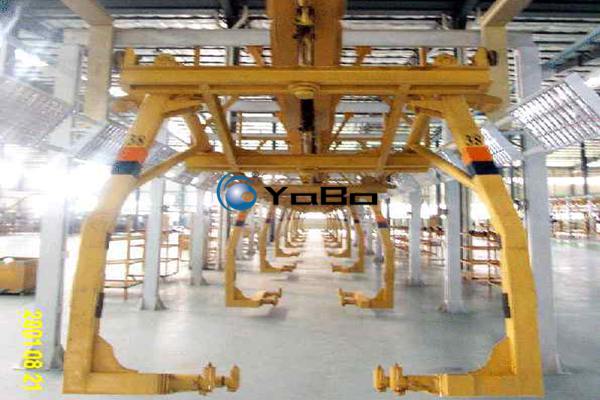
An EV assembly line, in engineering terminology, specifically means the continuous assembly system inside the final‑assembly workshop. Guided by a fixed production takt time, conveying equipment moves vehicle bodies sequentially, and operators at each workstation complete predefined assembly tasks within each takt cycle. The familiar sight of “bodies moving along the line while workers perform station‑based assembly” depicts this very system.
💡 Quick definition: EV production line = Full‑scope manufacturing system (broad concept) EV assembly line = Continuous assembly line within final‑assembly workshop (narrow concept; a component of the production line)
II. EV Production Line: Five Major Process Modules
A complete EV production line consists of the following process blocks:
1. Stamping Workshop
Large‑scale stamping presses shape steel or aluminium sheets into body panels such as doors, hoods and side frames, achieving precision within ±0.1 mm. To realise lightweight design, new‑energy vehicles widely adopt high‑strength steel and aluminium alloys, imposing higher requirements on stamping equipment and processes. With the maturation of large‑scale gigacasting technology, entire rear floor assemblies and front compartments can be cast in one shot, drastically reducing part counts and cutting production durations down to seconds.
2. Body‑in‑White Welding Workshop
Industrial robots weld hundreds of stamped parts into a complete body‑in‑white. Advanced welding lines deploy hundreds of collaborating robots, attaining nearly 100 % automation. New‑energy vehicles commonly use steel‑aluminium hybrid bodies. Conventional resistance spot welding cannot fulfil steel‑to‑aluminium joining requirements, so hybrid joining technologies such as laser welding, self‑piercing riveting (SPR) and adhesive bonding are widely deployed. Welding of battery‑pack housings demands extreme sealing performance and structural strength, hence high‑precision laser welding is standard practice.
3. Painting Workshop
Body‑in‑white units go through degreasing, phosphating, electrophoretic coating, intermediate coating, topcoat and clear‑coat finishing. This stage is subject to the strictest environmental regulations. New‑energy‑vehicle manufacturing has heightened environmental standards: water‑borne paints and high‑solid coatings are almost universally used, cutting VOC emissions by over 70 % compared with conventional painting. Additional anti‑corrosion and insulation treatments are applied to areas intended for battery installation.
4. Three‑Electric‑System Manufacturing (Core EV‑Exclusive Module)
This represents the fundamental difference separating EV production lines from traditional internal‑combustion‑engine production lines:
- Battery system: Individual cells undergo rigorous screening, then are assembled into modules via precision processes. Multiple modules, together with the battery‑management system (BMS) and sophisticated thermal‑management systems, are enclosed within robust battery‑pack housings. Battery‑module assembly requires constant‑temperature‑constant‑humidity environments, and battery‑pack air‑tightness testing equipment is mandatory.
- Motor: Permanent‑magnet synchronous motors dominate. Key processes include stator winding, rotor magnet insertion, full‑unit assembly and dynamic‑balance testing.
- Electronic control: Packaging and integration of power‑semiconductor modules (e.g. IGBT or SiC modules), covering PCB surface‑mount soldering, power‑module bonding, heat‑sink mounting, plus stringent sealing and thermal‑design work.
5. Final‑Assembly Workshop → i.e. the “EV assembly line”
Battery packs, drive motors, electronic control units, chassis assemblies, vehicle bodies, interior trims and low‑voltage electrical systems are assembled into finished vehicles. The final‑assembly line is divided into sub‑lines arranged by process sequence:
| Sub‑line | Core Operations |
|---|---|
| Trim line | Instrument panels, wiring harnesses, seats, glazing, door trims |
| Chassis line | Body‑to‑chassis marriage; overhead mounting of EV battery packs and electric‑drive assemblies |
| Exterior line | Bumpers, lamps, tyres |
| Testing line | Four‑wheel alignment, lamp calibration, water‑soak leak testing, high‑voltage safety checks |
New‑energy‑vehicle final‑assembly differs most sharply from ICE‑vehicle workflows: engines and gearboxes are eliminated, replaced by battery packs, motors and electronic‑control systems. Dedicated high‑voltage assembly zones are added to final‑assembly lines. Battery packs are generally hoisted and fitted as complete modules, and electric‑drive axles adopt modular assembly approaches.
III. EV Assembly Line: Process Focus of Final Assembly
Returning to the assembly line itself. It has become the public’s iconic image of EV manufacturing owing to three defining traits: Strict takt‑time driven operation The entire line runs at constant speed governed by takt time. Mainstream factories currently achieve cycle times of 53‑60 seconds per vehicle.
Standardised workstation operations Workstations along trim, chassis, exterior and testing sub‑lines complete assigned tasks within each takt cycle. The biggest distinction for new‑energy lines lies in battery‑pack handling: battery packs are lifted and mated as whole modules, requiring strict adherence to high‑voltage safety protocols.
Front‑loaded high‑voltage safety and electrical testing Critical safety checks including high‑voltage interlock verification, insulation‑resistance testing and ground‑resistance testing are performed on‑line rather than post‑off‑line. Charger‑test stations must incorporate pre‑planned high‑voltage protection measures.
Note: Processes such as gigacasting, body‑in‑white welding and battery‑pack manufacturing, though vital within EV production lines, do not belong to the “assembly line”. They are independent manufacturing units operating in parallel with, or upstream of, final assembly.
IV. Essence of the Process Difference: From Mechanical Assembly to Electric‑Drive Integration
Side‑by‑side comparison highlights the distinctions clearly:
| Comparison Dimension | EV Production Line | EV Assembly Line |
|---|---|---|
| Conceptual level | Macro‑scale manufacturing system | Continuous assembly line within final‑assembly workshop |
| Covered processes | Stamping, welding, painting, three‑electric manufacturing, final assembly, testing, logistics | Final assembly only (trim → chassis → exterior → testing) |
| Product transformation | Raw materials through to complete vehicle | Body‑in‑white through to complete vehicle |
| Core characteristics | Multi‑process‑module collaboration | Takt‑driven, workstation standardisation |
| EV‑specific processes | Gigacasting, steel‑aluminium hybrid welding, battery‑pack manufacturing | Battery‑pack hoist‑mounting, on‑line high‑voltage testing |
New‑energy assembly lines are not merely electrified retrofits of legacy automotive production lines. They represent production systems re‑engineered at the fundamental logic level. Complex engine‑gearbox powertrains give way to battery packs, motors and reduction gears, shifting manufacturing logic from “mechanical fitting” toward “component installation and system integration”.
V. Why Distinguishing These Two Concepts Matters
For industry practitioners, precise terminology underpins effective communication:
- Production‑line planning: A corporate brief to “build a new EV production line” means designing the full suite of stamping, welding, painting, three‑electric, final‑assembly and logistics facilities. By contrast, “retrofit the final‑assembly assembly line” refers only to local modifications: takt‑time optimisation, adding high‑voltage assembly workstations and similar adjustments. Investment scales, project timelines and technical complexity differ by orders of magnitude.
- Technical procurement & communication: Many purchasers only discover hidden requirements after equipment delivery. New‑energy‑line specifics include constant‑temperature‑constant‑humidity environments for battery‑module areas (requiring extra HVAC capacity for ordinary workshops), mandatory battery‑pack air‑tightness test equipment, and pre‑engineered high‑voltage safeguards for charger‑test stations.
- Industry understanding: The “product” handled by an EV assembly line has fundamentally changed: from a mechanical system centred on engines and gearboxes to an electronic‑electrified platform built around batteries, motors and electronic controls. This triggers cascading changes across manufacturing processes, material flows and information systems.
Key Takeaway: An EV production line is a ground‑up re‑engineered end‑to‑end manufacturing system encompassing stamping, welding, painting, three‑electric manufacturing and final‑assembly modules. An EV assembly line specifically denotes the continuous assembly workflow inside final assembly — it is one component of the production line, not the entirety. Grasping this conceptual distinction is essential for understanding the fundamentals of electric‑vehicle manufacturing engineering.
