SKD/CDK turnkey assembly lines for MC, 3W & Auto — EV ready.
Specializing in Vehicle Assembly Lines 30+ Countries · Quality-Driven · Full-Process Automation
Telephone:+86-15395152932
Home >> Latest developments >> Product Introduction of Motorcycle Production Line

Product Introduction of Motorcycle Production Line

Time:2025-10-16 17:04:14 Views:0times

Motorcycle manufacturing revolves around four core processes: stamping, welding, painting, and final assembly. Starting from raw materials, these four steps progressively transform steel sheets into a rideable motorcycle, each addressing a critical requirement: shape, structural strength, corrosion protection and aesthetics, and overall vehicle performance.

Overview of the Four Core Processes

Stamping: From Flat Sheets to Parts

This is the first operation. Raw materials primarily consist of cold-rolled steel sheets and aluminum alloys. Using high-precision stamping presses and dies, sheet metal components such as frame joints, fuel tanks, body panels, and guards are cut, drawn, and formed. Modern stamping lines are highly automated, with mature flexibility for multi-model changeovers. Dimensional tolerances are kept extremely tight—which directly determines whether subsequent welding and final assembly can fit together seamlessly.

Welding: Assembling Parts into a Frame

Dozens or even hundreds of stamped components are joined into a complete frame and body structure in the welding shop. The industry standard is robotic welding paired with dedicated fixtures, minimizing risks such as distortion, misalignment, and incomplete or missed welds. The job doesn’t end at welding—structural correction and non-destructive testing (NDT) are performed to catch hidden defects invisible to the naked eye. The frame’s rigidity and its ability to withstand high-speed riding and rough roads depend entirely on this process.

Painting: Corrosion Protection and Aesthetics

After welding, frames and body panels enter the paint line. The process flow is well established: degreasing and derusting → phosphating → electrophoretic primer → color coat → clear coat → high-temperature curing. The entire spraying environment is enclosed and dust-free, with strict control over paint film thickness, adhesion, and color consistency. This coating layer isn’t just for looks—its primary purpose is to completely isolate the metal from air, moisture, and salt. Inadequate corrosion protection means a frame can rust through in two years, leading to a flood of after-sales issues.

Final Assembly: Integrating Thousands of Parts into a Complete Vehicle

Painted frames arrive at the final assembly shop, where thousands of components—engine, transmission, brakes, suspension, wiring harnesses, body panels—are installed in sync with the production takt time. The assembly line employs intelligent torque tools and dedicated fixtures to prevent missing parts, incorrect installation, and loose fasteners. Once assembled, each unit undergoes comprehensive end-of-line inspection covering brakes, lights, speed, sealing, electrical circuits, and emissions. Issues like unstable idling or brake failure must be caught and resolved here.

Core Equipment for Final Assembly: Slat Chain Conveyor System

Among the four processes, final assembly is the last step and the critical stage where everything comes together. The centerpiece of the final assembly shop is the slat chain conveyor line that runs the full length of the hall. Currently, the vast majority of motorcycle manufacturers in China use a straight heavy-duty slat chain assembly line with dual-sided workstations.

Line Layout and Material Flow Logic

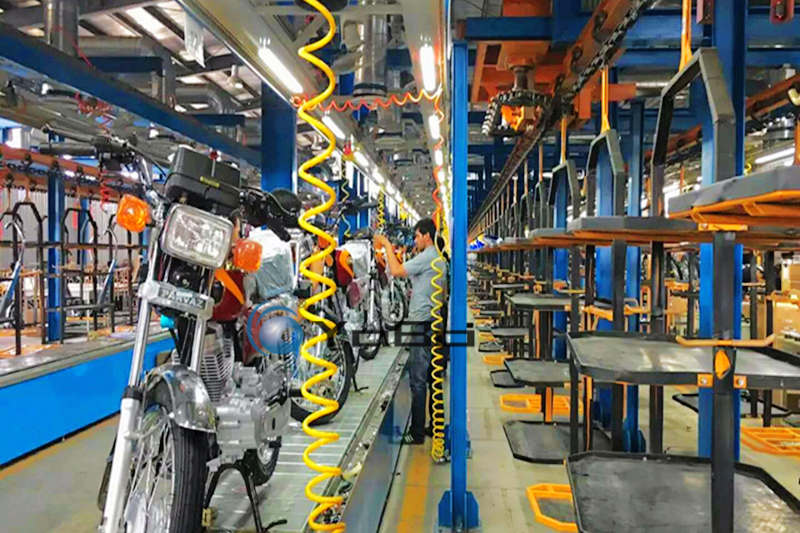
Observing the final assembly shop floor, the operating logic of this line is straightforward: motorcycles are placed upright directly on the steel slats of the chain, with the front wheel resting on the surface—wheels without additional pallets, boasting a simpler structure—meaning no extra pallets or dedicated tooling are required. The vehicle remains stable through its own weight and simple positioning devices, resulting in a very clean and minimal mechanical design. The slat chain advances at a set speed, while workers stand on both sides of the line, performing assembly tasks at their assigned fixed stations. Vehicles move, workers stay put, and materials are picked up nearby—this is the standard configuration for motorcycle final assembly lines.

Above the conveyor line, compressed air lines, lighting, and tool suspension rails are fully integrated. On the right side of the line, multi-tier suspended material baskets are typically installed, storing high-frequency small parts such as bolts, washers, and body panels. Workers can reach for them without walking back and forth, minimizing takt time loss.

Key Parameters

Slat chain conveyor parameters are fully customized based on the complete vehicle assembly process:

Parameter Typical Range Notes
Slat width 500mm – 1800mm Covers everything from underbones to mid-to-large displacement motorcycles
Station load capacity Several hundred kg – 2 tons Capable of handling heavy-duty models
Conveying speed 0.4 – 4 m/min Variable frequency or electromagnetic speed control
Operation mode Continuous or intermittent tact Stops at each station for a fixed duration, resumes after task completion
Station spacing 500mm – 1000mm Determined by operation content
Number of stations 20 – 40 Per single line
Takt time per unit 2 – 5 minutes Used to calculate single-shift output

Mechanical Structure

A slat chain conveyor is not a highly sophisticated piece of equipment, but it faces stringent reliability demands—it must endure long-term loads from the complete vehicle weight, workers stepping on it, and impact forces generated during assembly. The core components are as follows:

  • Chains: Mostly double-pitch roller chains or leaf chains.
  • Slats: Stamped from steel plates with flat surfaces to directly support the wheels. Materials are typically galvanized carbon steel or stainless steel to resist oil, water vapor, and metal debris.
  • Guide rails: Commonly welded from channel steel or H-section steel.
  • Machine frame: Steel structure with powder-coated finish.
  • Drive unit: Variable-frequency or electromagnetic speed-control motor paired with a reducer to deliver torque.
  • Control components: Limit switches, photoelectric sensors, and encoders enable automatic start/stop, station identification, and interlock protection.
  • Tensioning unit: Compensates for chain elongation over time to ensure smooth transmission without slipping or jamming.


Routine Maintenance

The principle is simple, but neglecting maintenance leads to problems quickly. Daily upkeep boils down to three tasks: chain lubrication, guide rail cleaning, and slat fastener tightening. Lubrication is typically handled by automatic drip-oil or brush lubricators arranged along the guide rails. If maintenance is skipped, chains are prone to skipping teeth and jamming, and worn slats can develop surface indentations, making the vehicle unstable on the line and directly compromising assembly accuracy.


Product Introduction of Motorcycle Production Line